
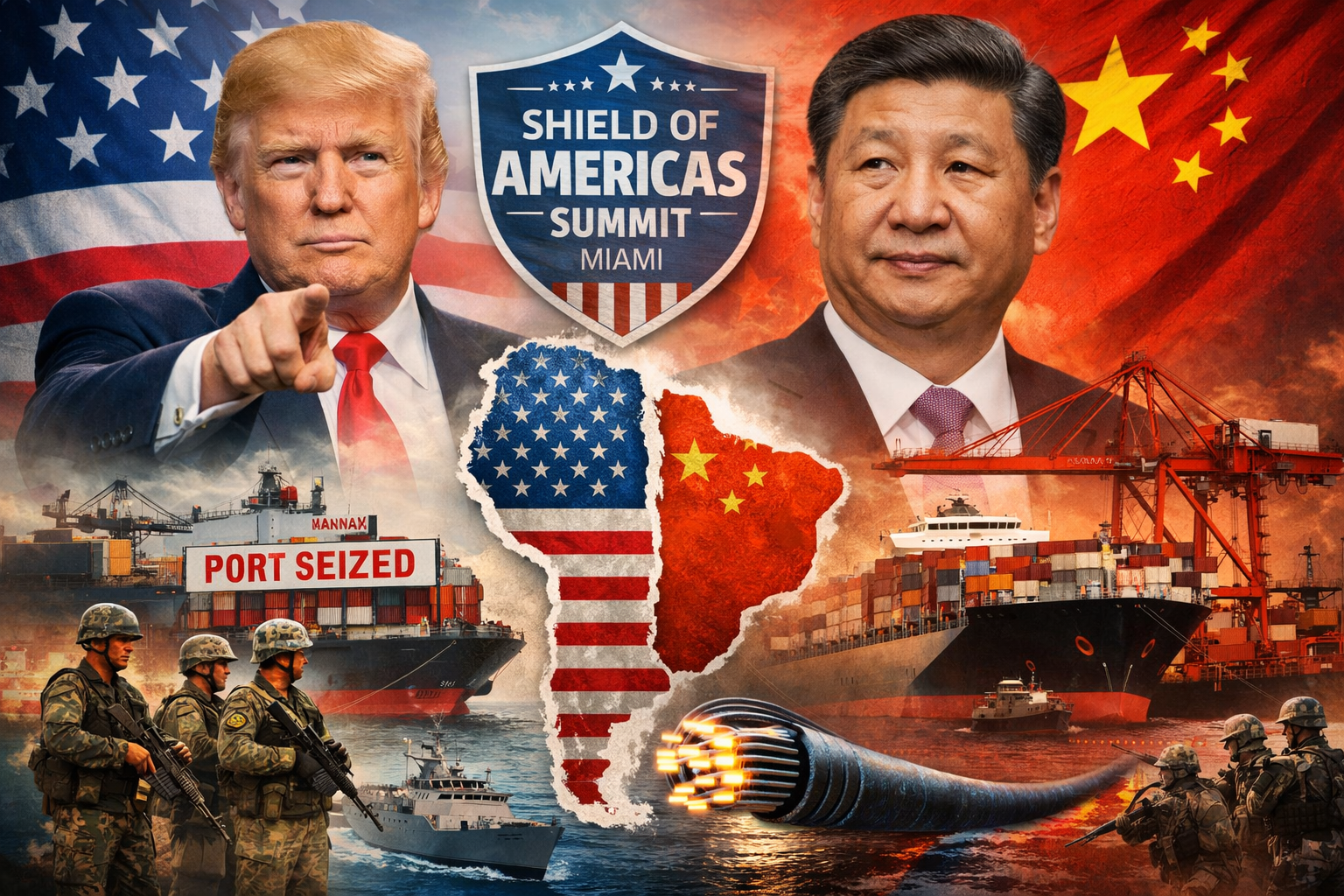
The United States has taken several steps to reduce China’s growing influence in Latin America. Recently, the U.S. imposed travel bans on three officials from Chile due to concerns about a planned submarine fiber-optic cable project that involves China. At the same time, the U.S. has also warned Peru about the strategic risks of allowing Chinese companies to control a large newly built port.
In Panama, the government has taken control of two ports that were previously operated by a Hong Kong-based company. This move came after pressure from former U.S. President Donald Trump, who has repeatedly spoken about regaining stronger control over the Panama Canal. These developments are part of a wider effort by the U.S. to counter China’s growing economic presence across the region.
U.S. Strategy in the Region
The Trump administration has increased its diplomatic and economic engagement with Latin American countries in an attempt to limit China’s dominance. As part of this strategy, Trump is planning to host a summit for Latin American leaders at his golf resort near Miami, calling the initiative the “Shield of Americas.”
Supporters of this approach believe it is necessary to prevent China from gaining too much influence in the Western Hemisphere. They argue that China’s expanding presence in trade, infrastructure, and investment could shift global power toward Beijing. However, critics believe such a direct strategy may be difficult because China has already built strong economic ties with many countries in the region.
A Difficult Choice for Latin America
Experts say Latin American countries may soon face pressure to choose between the United States and China. Francisco Urdinez, a political science professor at the Pontifical Catholic University of Chile, explained that many countries prefer to maintain relationships with both powers rather than take sides.
He pointed out that in 2001, Cuba was the only Latin American country that traded more with China than with the United States. By 2021, however, most South American countries—except Paraguay and Colombia—were doing more trade with China.
China’s Expanding Economic Role
China has become an important partner for Latin American nations, especially in areas like infrastructure and development. According to Rebecca Ray from Boston University’s Global Development Policy Center, China has invested heavily in sectors where the United States has not been very active.
Between 2014 and 2023, China provided about $153 billion in loans and grants to Latin America and the Caribbean. In comparison, the United States provided around $50.7 billion, showing the scale of China’s financial involvement in the region.
U.S. Security Concerns
The U.S. government has acknowledged that its influence in the Western Hemisphere has weakened over the years. In its recent National Security Strategy, the U.S. emphasized the need to prevent external powers—especially China—from controlling critical infrastructure and strategic assets in the region.
China’s growing economic presence has also strengthened its diplomatic influence. Several Latin American countries have even shifted their diplomatic recognition from Taiwan to Beijing in hopes of gaining better economic opportunities.
Balancing Relationships
Experts believe Latin American countries will try to balance their relationships with both the United States and China. Enrique Millán-Mejía from the Atlantic Council noted that the U.S. must offer strong investment opportunities if it wants to compete with China’s financial influence.
While some countries have concerns about the long-term benefits of Chinese investments, many still see China as an important economic partner.
China’s View
From China’s perspective, its involvement in Latin America is mainly focused on business and economic cooperation. Sun Yun from the Stimson Center said China does not see its activities as a direct competition with the United States, but rather as a way to protect and expand its investments.
However, China expects political support from its partners, especially regarding sensitive issues like Taiwan.







Leave a Reply