
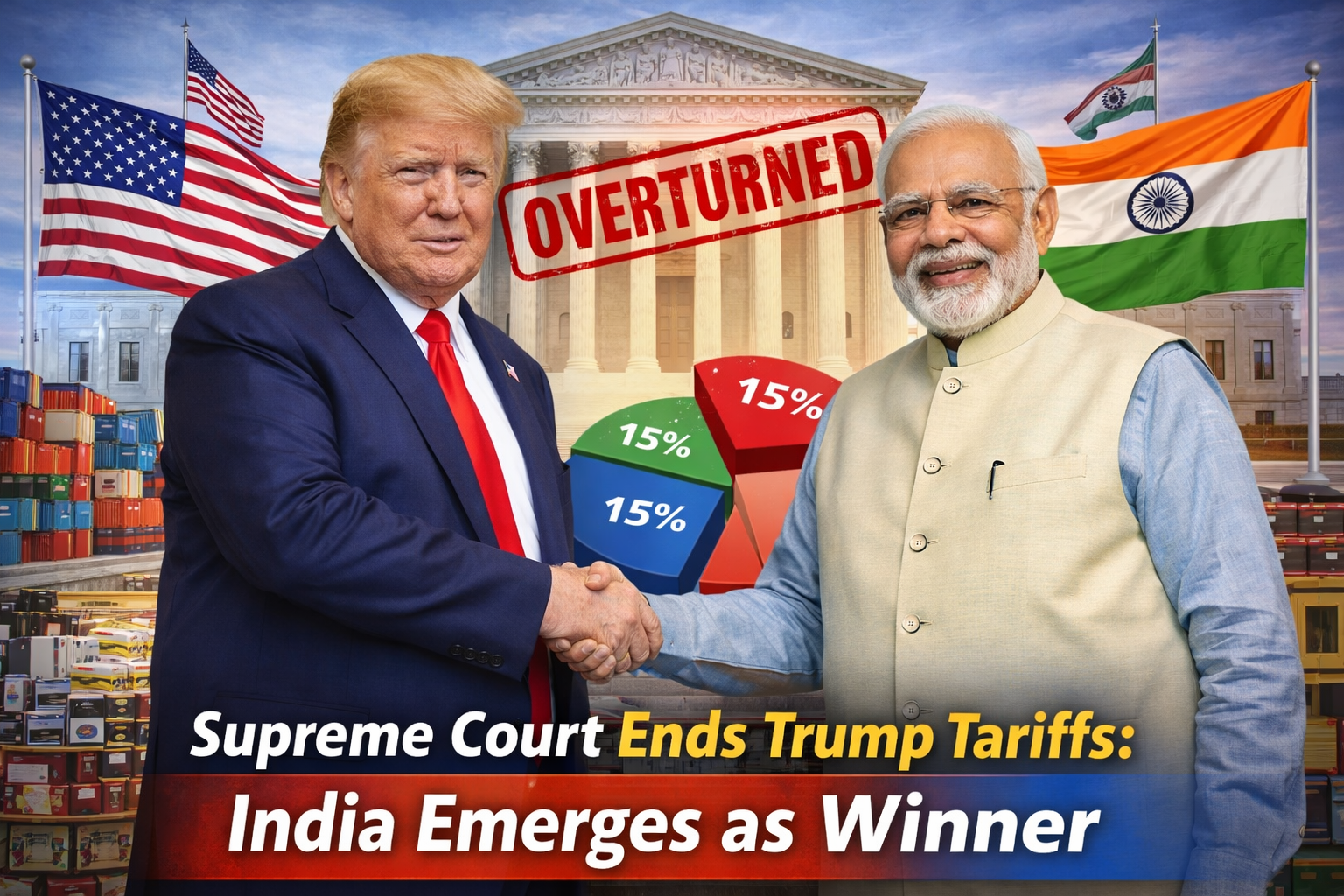
The US Supreme Court has invalidated former President Donald Trump’s reciprocal tariffs that were imposed under the International Emergency Economic Powers Act (IEEPA). The decision has triggered a fresh shift in global trade policy and could reshape trade relations for several emerging economies, including India.
The ruling effectively removes the sweeping tariff powers that had been used aggressively in 2025, marking a potential reset in US trade strategy.
Trump Administration Responds with 15% Blanket Tariff
Following the court decision, the Trump administration introduced a temporary 15% global tariff under Section 122. This provision allows short-term import restrictions (up to 150 days) to address balance-of-payments concerns.
According to brokerage firm Emkay Global Financial Services, the effective US tariff rate now stands at around 14%, down from 16% before the court ruling and significantly lower than the peak of nearly 28% seen in April 2025.
This adjustment reduces immediate pressure on trading partners and places most countries on more equal footing compared to the earlier aggressive tariff regime.
Sector-Specific Tariffs Still in Place
While the broader IEEPA tariffs have been struck down, sector-specific tariffs under Section 232 remain active. These apply to steel, aluminium, copper, and automobiles.
Countries such as Japan and South Korea may continue to feel greater pressure due to their auto exports to the US. India’s exposure, however, is more limited and largely indirect through steel and aluminium inputs.
Potential Fiscal Impact on the US
Since April 2025, the US reportedly collected between $140–175 billion in customs revenue under IEEPA. With the Supreme Court ruling, questions arise over whether these funds will need to be refunded. If refunds occur, it could create a short-term fiscal stimulus effect in the US economy.
Rebuilding Tariff Leverage May Be Difficult
Although the administration can explore other legal routes—such as Sections 232, 201, 301, and 338—these mechanisms are either sector-specific, legally challenging, or time-consuming.
Political factors may also limit aggressive tariff actions. Falling approval ratings and the upcoming US midterm elections in November 2026 could restrain further escalation.
Why India May Benefit
Emkay views the ruling as positive for India.
Around 55% of India’s exports to the US will now face only a 15% tariff.
Nearly 40% of exports, including electronics, pharmaceuticals, and petroleum products, remain exempt.
Only a small portion falls under Section 232 tariffs.
As a result, India’s effective tariff rate is expected to be in the 11–13% range, which compares favorably with China’s rate (above 15%) and is broadly similar to other Asian economies.
The brokerage also noted that while India may technically have flexibility to increase purchases of Russian crude oil, it is likely to act cautiously to maintain stable relations with Washington.
Outlook: Trade Uncertainty Continues
While the Supreme Court ruling reduces immediate trade pressure, global uncertainty remains. Countries may reconsider previous commitments made under heavier tariff threats, especially now that headline tariffs are capped at 15% under Section 122.
In summary, the ruling narrows US trade leverage but avoids a full-scale tariff escalation—offering relative relief to emerging markets, with India positioned as one of the key beneficiaries.







Leave a Reply