
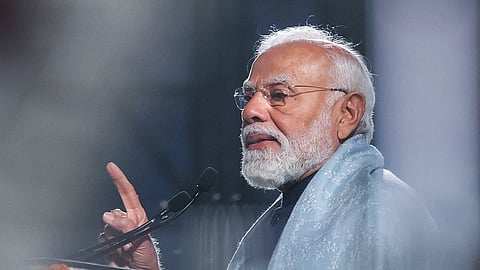
Prime Minister Narendra Modi has described the Union Budget 2026 as part of a broader long-term strategy rather than a conventional financial document, emphasising that his government’s approach goes beyond presenting a routine “bahi khata” or accounting exercise. In an interview, Modi framed the budget as a continuation of a long-term development roadmap aimed at positioning India as a developed nation by 2047.
Budget as a Strategic Roadmap, Not a Compulsion
According to the Prime Minister, the latest budget should not be viewed as a response to immediate economic pressures or a “now or never” moment. Instead, he characterised it as a “we are ready” phase — reflecting preparation, policy continuity, and confidence in India’s economic direction. The government’s intent, he suggested, is to maintain momentum built over the past decade while laying the groundwork for future growth.
Modi argued that since 2014, Union Budgets under the NDA government have been designed with long-term goals, clear timelines, and implementation-focused planning rather than short-term announcements. Each budget, he said, builds on previous policy decisions, creating continuity in reforms and development initiatives.
Linking Budget Policy to the Vision of Viksit Bharat
The Prime Minister placed Budget 2026 within a historical and strategic context, comparing current policy decisions to those made during the early decades of the 20th century that eventually contributed to India’s independence. He suggested that today’s economic and policy choices are intended to lay the foundation for a developed India by 2047, marking 100 years of independence.
This framing positions the budget not merely as an annual fiscal exercise but as part of a multi-decade national development plan focused on sustained economic growth, infrastructure expansion, and institutional reform.
Economic Stability and Social Transformation
Beyond economic metrics, Modi emphasised behavioural and social changes as essential components of development. He argued that nation-building involves shifts in social habits and civic responsibility alongside economic progress, suggesting that public participation and societal transformation are integral to achieving long-term national goals.
The Prime Minister also highlighted India’s economic resilience, noting that the country continues to show strong growth despite global economic uncertainties. According to him, macroeconomic stability, controlled inflation, and policy consistency have strengthened investor confidence and international partnerships.
Emerging Sectors Driving Future Growth
Modi pointed to emerging sectors such as space technology, sports, and startups as examples of India’s evolving growth story. He noted that a young and increasingly skilled population, combined with political stability and reform-oriented governance, is creating new opportunities for innovation and global collaboration.
The post-pandemic global environment, he said, has opened new avenues for trade and technology partnerships, with several countries looking at India as a key economic partner.
Analysis: Budget as a Continuity Narrative
From an analytical perspective, the Prime Minister’s remarks position Budget 2026 as part of a continuity narrative — one that seeks to link past reforms, present policy actions, and future aspirations into a single long-term framework. By presenting the budget as an instrument of strategic planning rather than annual accounting, the government aims to reinforce confidence in policy stability and long-term economic direction.
In essence, the message surrounding Budget 2026 reflects an attempt to move the public discourse beyond yearly fiscal numbers toward a broader vision of structural transformation and national development over the next two decades.



Leave a Reply