
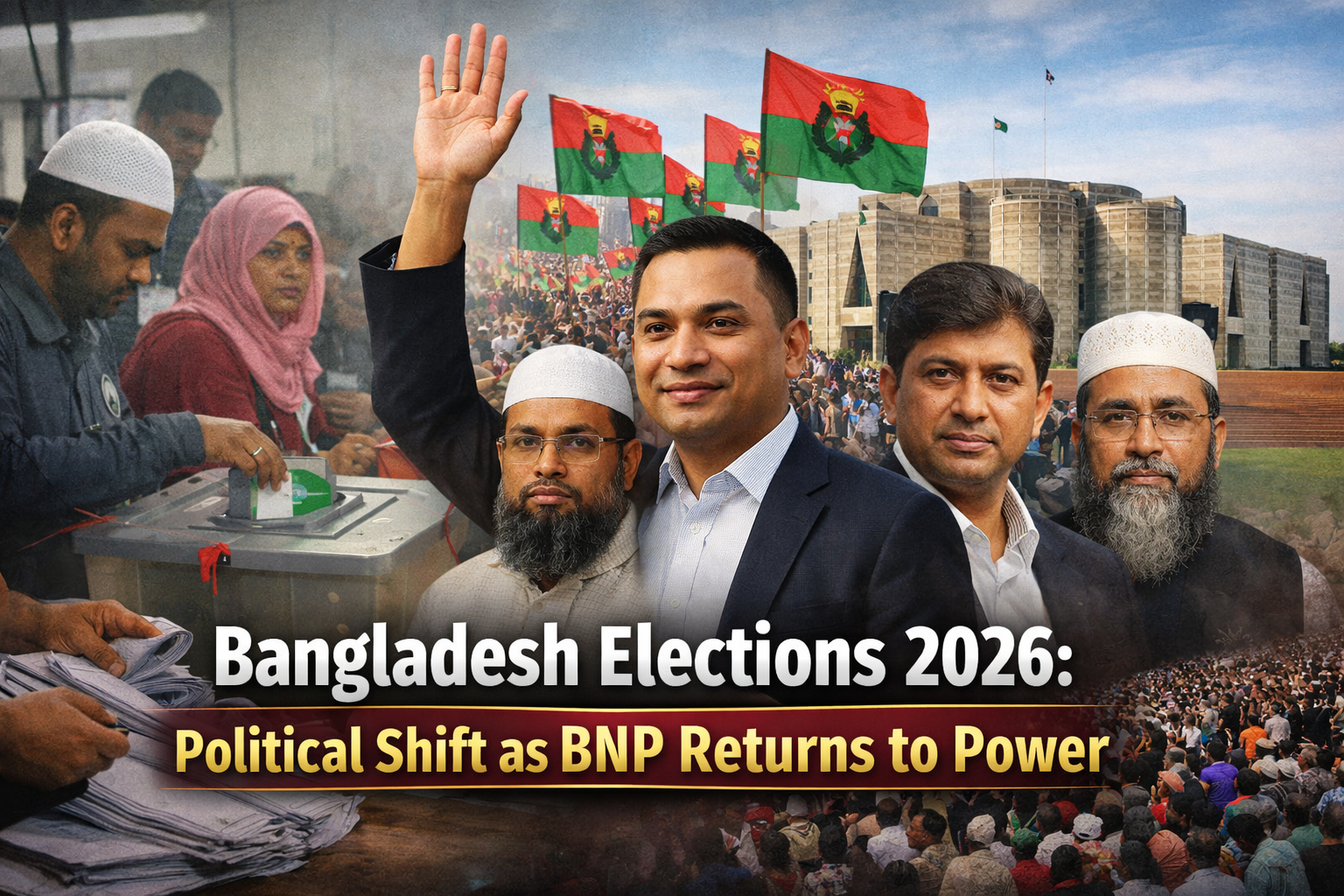
Bangladesh’s recent national elections have brought a major political shift, ending the long-standing dominance of the Awami League and returning the Bangladesh Nationalist Party (BNP) to power with a clear majority. The outcome marks a significant change in the country’s political direction and is being closely watched by regional stakeholders, especially India.
The elections were held in the backdrop of political instability following the removal of former Prime Minister Sheikh Hasina in August 2024. With BNP’s victory, party chief Tarique Rahman is now set to assume the role of Prime Minister, signalling a new phase in Bangladesh’s domestic and foreign policy outlook.
A key point of discussion surrounding the election results has been the return of several controversial political figures. Three former convicts, including individuals previously accused in anti-India terror-related cases, secured electoral victories. Their comeback became possible after Bangladesh’s High Court acquitted Tarique Rahman, Lutfozzaman Babar, and others in December 2024 in connection with the 2004 grenade attack that had targeted Sheikh Hasina. The verdict effectively cleared legal barriers to their political participation.
Another notable winner was Abdus Salam Pintu, who had earlier faced allegations of links with the Pakistan-based militant organisation Harkat-ul-Jihad-al-Islami (Huji). The group has been associated with multiple attacks in India, including the 2006 Varanasi court blasts. Following his acquittal, Pintu contested the elections and won his constituency by a significant margin.
ATM Azharul Islam, a senior leader of Jamaat-e-Islami, also emerged victorious. Previously accused of war crimes during Bangladesh’s 1971 Liberation War, including involvement in mass killings and sexual violence, Islam was cleared of charges during the interim administration led by Nobel Laureate Muhammad Yunus, which assumed power after Hasina’s removal.
The election results have raised strategic concerns in New Delhi, as the rise of leaders perceived as critical of India could reshape bilateral relations. Analysts suggest that the new government’s foreign policy choices and regional engagement will be closely monitored in the coming months, particularly regarding security cooperation and cross-border stability.
Overall, the election represents not just a political transition but a potential turning point in Bangladesh’s internal power dynamics and its geopolitical positioning in South Asia









Leave a Reply