
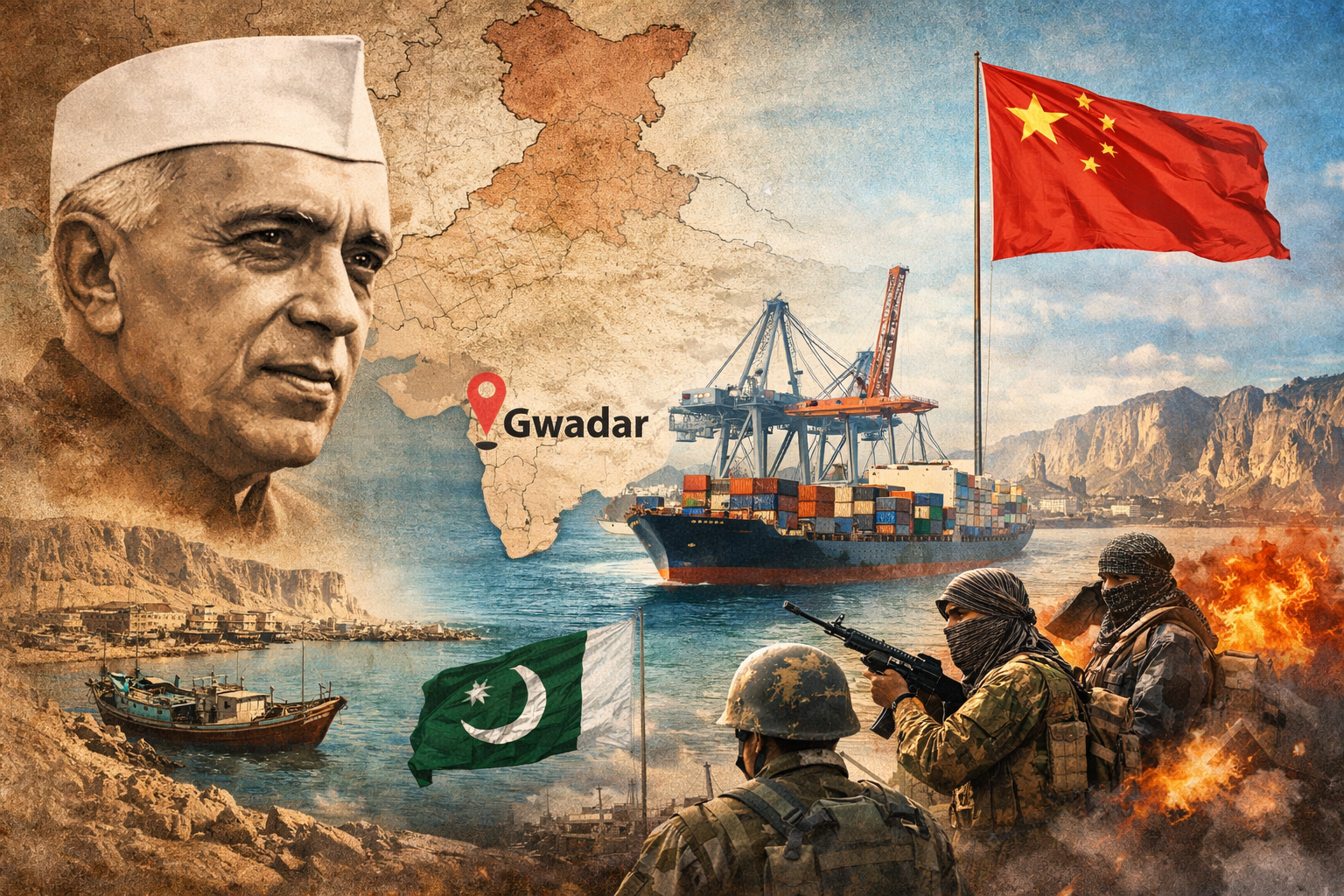
Gwadar Port, located near the strategically vital Strait of Hormuz, has evolved from a quiet fishing settlement into one of South Asia’s most geopolitically significant locations. Its story traces back to a crucial decision made in the 1950s — when India declined an opportunity to acquire the port — and continues today amid unrest in Pakistan’s Balochistan province and shifting regional dynamics.
Nehru’s Decision in the 1950s
In 1956, Oman’s Sultan Said bin Taimur reportedly offered to sell Gwadar to India for about £3 million. At the time, Prime Minister Jawaharlal Nehru, guided by senior advisors including Foreign Secretary Subimal Dutt and Intelligence Bureau chief B.N. Mullick, chose not to proceed with the purchase.
The primary concern was strategic vulnerability. Gwadar had no land connection to India and was surrounded by what would become Pakistani territory, making it difficult to defend or supply. Indian officials feared it could turn into an isolated outpost prone to military and logistical risks, particularly in the tense years following Partition. With limited financial resources and more immediate domestic priorities, New Delhi viewed the acquisition as an unnecessary strategic gamble.
Pakistan later purchased Gwadar from Oman in 1958 and formally integrated it into its territory in 1960, transforming it over time into a deep-sea port with significant strategic potential.
Gwadar’s Strategic Importance
Gwadar’s value lies in its proximity to the Strait of Hormuz, one of the world’s busiest energy corridors through which a large share of global oil shipments passes. The port offers Pakistan access to deep-water maritime trade routes and serves as a potential gateway for commerce with Central Asia and beyond.
In later decades, Gwadar became a centerpiece of large infrastructure and connectivity projects, increasing its importance in regional trade and security calculations. The port’s location has made it both an economic opportunity and a strategic asset in broader regional competition.
The Balochistan Challenge
Despite its strategic promise, Gwadar’s development has been overshadowed by instability in Balochistan. Local grievances over resource distribution, development benefits, and political representation have fueled long-running tensions in the province. Insurgent attacks, including those by the Balochistan Liberation Army (BLA), have targeted security forces and infrastructure projects, disrupting operations and raising concerns about long-term stability.
The unrest highlights a central paradox: while Gwadar offers strategic advantages, internal security challenges continue to complicate its full potential.
China’s Role and Cautious Approach
Gwadar is also closely linked to China’s broader regional infrastructure ambitions. However, recurring security incidents have reportedly led to a more cautious operational approach, with Chinese personnel reducing their on-ground presence while continuing involvement through remote coordination and security adjustments. For Beijing, the port remains strategically important due to its potential to shorten energy and trade routes between the Middle East and western China.
A Strategic Miss or Practical Choice?
In hindsight, some analysts view India’s rejection of Gwadar as a missed strategic opportunity, given the port’s current importance. Others argue that the decision reflected the realities of the time — limited resources, fragile regional relations, and significant logistical challenges.
Today, Gwadar stands as both a strategic asset and a source of ongoing tension. Its history illustrates how geopolitical decisions made decades earlier continue to shape regional politics, trade routes, and security debates across South Asia.








Leave a Reply