
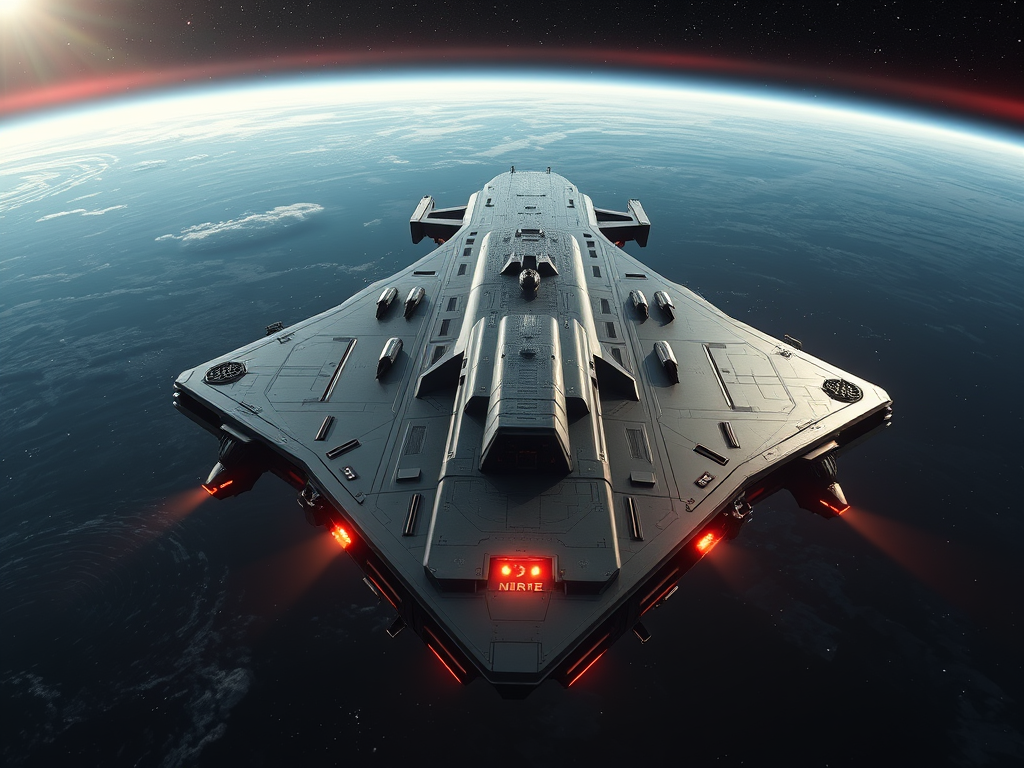
China has unveiled a futuristic military concept that appears drawn from science fiction — a proposed space-based aircraft carrier designed to operate at the edge of Earth’s atmosphere. The project, known as Luanniao, is part of China’s broader Nantianmen (South Heavenly Gate) programme, which aims to explore next-generation aerospace and near-space military capabilities.
Presented through promotional material released by Chinese state media, the concept depicts a massive triangular platform intended to function as a high-altitude combat base capable of deploying unmanned aerial systems and conducting long-range strikes from near space.
A Massive Near-Space Platform
According to publicly released visuals, the Luanniao platform is envisioned as an enormous structure measuring roughly 242 metres in length and 684 metres in width, with an estimated weight of around 120,000 tonnes — significantly larger and heavier than modern aircraft carriers currently in service.
The concept proposes that the platform could carry up to 88 unmanned combat drones, reportedly equipped with stealth features and hypersonic weapons. Operating at the edge of the atmosphere, such a system would theoretically remain beyond the reach of conventional air defence systems and fighter aircraft, allowing rapid deployment of aerial assets across large distances.
If realised, analysts suggest the concept could potentially reshape aerial warfare by extending military operations into near-space environments.
Strategic Implications and Global Concerns
The announcement comes at a time of rising geopolitical tensions, particularly in regions such as the South China Sea and around Taiwan, where military competition between China and the United States continues to intensify. A near-space platform capable of sustained operations could, in theory, provide strategic advantages in surveillance, rapid response, and long-range strike capability.
Some defence analysts argue that concepts like Luanniao are intended not only as technological proposals but also as strategic signalling, demonstrating China’s ambitions in advanced aerospace and military innovation.
Experts Remain Sceptical
Despite the ambitious claims, many global defence experts remain cautious about the feasibility of such a project. Current technological limitations pose significant challenges, particularly in propulsion, energy requirements, and maintaining a platform of this scale at near-space altitude.
Experts note that launching or sustaining a structure of this size would require reusable heavy-lift launch systems comparable to those developed by private space companies, technology that China is widely believed to still be years away from fully mastering.
As a result, several analysts view Luanniao primarily as a conceptual design or long-term vision rather than an operational system expected in the near future.
Part of a Larger Aerospace Vision
The Nantianmen programme reportedly includes a range of advanced aerospace initiatives beyond the space carrier concept. These include next-generation fighter aircraft designed to operate at extremely high altitudes, blurring the line between aviation and spaceflight. China previously showcased a model of a near-space aircraft known as Baidi during a major aviation exhibition in 2024.
At the same time, China’s progress in space exploration remains tangible. Missions such as Chang’e-6, which successfully returned samples from the Moon’s far side, highlight the country’s growing capabilities in space technology and long-term exploration planning.
The Future of Warfare Moves Toward Near Space
Whether the Luanniao concept becomes reality or remains theoretical, analysts agree on one point: future military competition is increasingly extending beyond traditional air and sea domains into near-space environments.
The concept reflects a broader global trend where space and high-altitude platforms are expected to play a larger role in surveillance, communication, and potential conflict scenarios in the decades ahead









Leave a Reply